
Residencies · Schools and organizations
Two school weeks, and the poems to show for it.
A workshop is one visit. A residency is me in your school every day, usually 10 to 14 teaching days. Students learn poetry, and they get to know me, and that changes what they’re willing to try.
School residency read-in week
What is an Artist-in-Residence, and why bring one into your school?
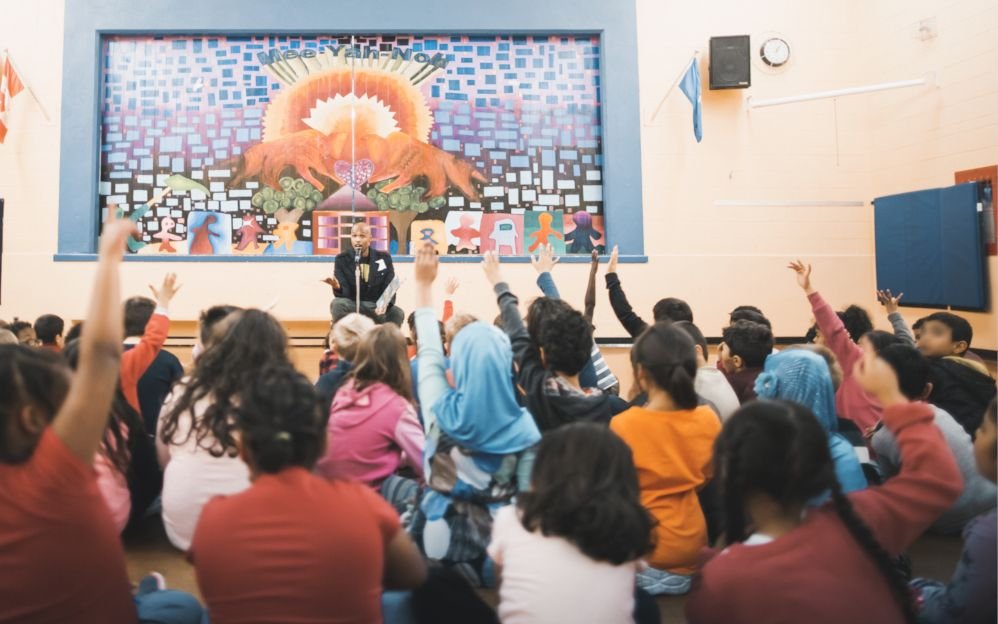
An artist in residence is a working artist who joins your school for a stretch of days. Instead of one show or one workshop, I’m in your classrooms every day doing hands-on work with students. That daily contact builds trust, and the skills go with students beyond school.
Why me
I’ve taught K–12 students for 15 years. I came to Canada as a refugee, and English wasn’t my first language, so when a student can’t find the right word, I know that feeling. I served as Edmonton’s 7th Poet Laureate, and I bring years of youth work, community building and board experience into the classroom.
I treat every student as a writer from the first day, and I work to break down the wall between “school mind” and “home mind.” I believe we are all born poets, engineers, doctors and lawyers, and what we spend our time on decides what we become. So I don’t let a student’s self-doubt stand in the way, and I don’t let the classroom become a place where a kid decides “that’s not for me” before they’ve tried it.
What actually happens
I build the schedule and lesson plans with the school, not around it. I work inside the block structure, specials rotation or timetable you already run. You don’t have to rebuild your schedule for me.
I’m not only in the classroom running lessons. I spend time with students in the hallway, at lunch, wherever it happens, and talk with them about what they’re into: manga, anime, video games, basketball, rap. Students open up to someone who gets to know them and takes an interest in what they care about. That trust makes it easier for them to join in.
The Bus writing exercise. Ask a student how their day was and most will say “it was good” and stop there. The Bus Exercise teaches them to notice detail instead. When you get on a bus, you don’t just get on it. You see things, smell things, hear things, feel things, taste things. Students write down everything a bus ride actually involves, using all five senses, and it shows them just how much is happening around them every single day, whether they notice it or not. Once they can catch that much detail on a bus ride, they have what they need to write about anything.
The Fire Exercise. I ask the class a simple question: is fire good or bad? Some say good, some say bad. Then I give them two situations. Someone spends their whole life working toward owning a home, and the day they finally get it, it burns down. Is fire good or bad? Bad. Someone is stranded in the wilderness with no way to get warm or cook food and finally manages to start a fire. Is fire good or bad? Good. If those two people ended up in the same room arguing about whether fire is good or bad, would either one be wrong? No. Both are right because of what they lived through. The exercise is less about fire than about teaching students that someone else’s perspective can be just as true as their own, without ever needing to say it that directly.
I also work with Connections and Care classrooms for students who need extra support. At Belvedere, I built that part of the residency around rap and rhythm, because that was the right way in for that group. At Aldergrove, it looked different. The format is flexible. I adjust to what the room needs.
Workshop or residency?
| Workshop | Residency | |
|---|---|---|
| Duration | 1–5 days | 10 to 14 teaching days (schools), weeks–months (organizations) |
| Student contact | 1–3 sessions | Daily sessions; students see me every day |
| Outcome | Students experience poetry and learn fundamentals | Students make poetry their own and perform it |
| Best for | Poetry units, special events, author visits | School-wide projects and longer-term change |
When I’m in your school for days in a row, students get repeated practice with the same artist, and you can watch the shift from “I can’t write poetry” to “I’m a poet.”
For schools
What a school residency looks like.
A school residency usually runs 9 to 14 teaching days. I’m in your building every day, teaching poetry to classes across several grades. Week one builds trust and the basics through sensory writing, identity exercises and low-stakes sharing. Week two deepens the craft, works on performance, and builds toward a showcase.
Teacher support
Pre-residency planning consultation, an optional teacher PD session, daily communication, and lesson plans to keep the poetry going after I leave.
A good fit for: elementary schools that want the arts across the whole school, middle and high schools building literacy and identity programs, schools with equity and inclusion goals, and districts with artist-residency funding. See Curriculum Alignment below for how sessions map to Alberta outcomes.
Get in touch as early as you can, but I can work with shorter notice. Popular windows: October–November and February–April. Avoid December and June.
Recent residencies.
In October 2017 I was the City of Terrace’s writer in residence for a week, based at Caledonia Senior Secondary in Terrace, BC, with sessions at a second school, the public library and two community centres.
Impact, assessment, and results.
All three residencies followed the same arc: identity and school-community writing, craft taught at each grade’s level, rehearsal, and a showcase or assembly that brought students, families and staff into one room.
Assessment methodology
Process and product rubrics tracking voice, revision, specificity, and oral sharing; student reflection prompts; teacher observation. I can send the materials and the detailed Alberta ELA alignment guide.
The Poetry Café.
My school residencies end with a showcase, usually a Poetry Café. Students share their own writing with families, teachers, classmates and the community, with support. It gives them a public reason to revise, rehearse and trust their own words. It’s about communication (pacing, volume, presence, respect for each reader), not competition.
The structure moves through revision, rehearsal, stage setup, hosting, student performance, community celebration, and documentation when consent is available. For students, it’s a public reason to trust their own language. For families, it’s a chance to witness student growth without exposing private classroom details. For schools, it’s a closing event that brings students, teachers, leaders, and families into one room.
Belvedere’s residency in April 2025 ended with a Poetry Café, part of its 47.3 program hours. Students who don’t often get to celebrate their writing came with their parents and shared their poems.
For organizations
Organizational residencies.
I can also bring a residency to your workplace, non-profit or community organization. We shape it around your team’s schedule and goals, over weeks or months instead of the fixed school format.
Intensive retreat
2–5 consecutive days, on- or off-site, morning sessions plus afternoon integration, culminating in a group showcase.
What we can work on: communication across teams, a creative outlet for stress, public speaking, and equity work, which I bring from chairing the Edmonton Arts Council’s Equity Committee. Past organizational work includes teacher professional development for school districts.
Every format is customizable to your organization’s size, budget, and timeline. Non-profit discounts available on inquiry. Earlier is better, but I can work with shorter notice.
Curriculum alignment.
For the coordinator who has to approve a booking: my sessions map to Alberta Language Arts outcomes for K–6, 7–9 and 10–12 in writing, speaking, listening, reflection and performance.
Social Studies
Identity, migration, community, belonging, public memory, place-based storytelling.
Visual Arts
Sensory and community-poem activities pairing language with mapping, imagery, display, and performance artifacts.
Outcomes are paired with evaluation criteria, rubrics, student reflection and teacher observation. I can send the General Outcome codes for each workshop.
Which residency is right for you?
| Feature | School residency | Organizational residency |
|---|---|---|
| Duration | 10 to 14 teaching days (standard) | Flexible (4 weeks–12 months) |
| Format | Intensive daily sessions | Tailored to work atmosphere |
| Audience | Students, Grades K–12 | Adults: staff, teams, leadership |
| Culmination | Poetry Café (family event) | Performance, retreat, or showcase (optional) |
| Lead time | As early as you can; shorter notice is possible | As early as you can; shorter notice is possible |
Funding a residency.
Cost is often the first question a school has about an Artist-in-Residence program. The more useful question is: how much of the residency does the school actually have to fund?
Alberta already has funding meant to help schools bring professional artists into K–12 classrooms. I also have experience finding, applying for and completing grants, and I can help your school look for funding beyond the AFA program. I’ll help build the residency, and I’ll help build the application.
Alberta Foundation for the Arts: Artists and Education Funding
The Alberta Foundation for the Arts offers funding for professional artist residencies in Alberta schools, which may cover part of the artist’s fee. Check the AFA’s current guidelines for amounts and eligibility. Funding is competitive and is not guaranteed, but the program exists specifically to help schools make residencies like this possible.
You don’t have to write the grant from scratch
The school must submit the AFA application, but I can help prepare the project description, residency objectives and expected student outcomes, curriculum connections, a detailed schedule, artist biography, fee breakdown, and the Artist Residency Fee Confirmation Form. The school still controls and submits its own application. It just doesn’t have to start from a blank page.
Many grants operate on fixed application cycles and funding is often competitive, so schools interested in a residency should begin the conversation early. If cost is the reason a residency hasn’t happened yet, start with funding. The full price of a residency and what your school ends up paying can be two very different numbers.
Fair pricing, built around your scope.
I price school and organizational residencies by their actual shape: how long they run, how many classes or teams take part, and any travel. There’s no flat rate. As shown above, AFA funding and other grants can cover a significant share of the cost. Pro bono and reduced rates are considered for schools and community organizations in high-needs areas.
Get in touch with your dates, school or organization size, and goals, and I’ll follow up with a clear quote.
Residency FAQ
Why 9–14 days for school residencies?
Early days build trust and the basics. Later days deepen the work and get students ready to perform. Seeing me every day gives students a routine and a relationship.
Can we do a shorter residency?
Yes. Shorter intensives (5–7 days) are available for schools with budget or scheduling constraints, though I recommend the longer format.
How many students can participate?
Residencies work well with 100–400 students. Belvedere 2025 served 297 students across 10 grade levels. Smaller schools can engage everyone; larger schools may focus on specific grades.
What does “tailored to your organization” mean?
Every organization is different. Programming is designed to fit your schedule, your culture, and your specific goals, whether that’s team-building, equity work or communication training, and organizational residencies don’t require a public showcase the way school residencies do.
What if students say “I’m not creative”?
That’s who residencies are for. Sentence frames give non-writers an easy way in, and reluctant students often end up writing and sharing.
Can we combine a residency with a keynote or performance?
Yes. Many schools book an assembly performance at the start of the residency, or have me perform at the Poetry Café. See Services for keynotes and performances, which can be bundled with a residency.
General booking and funding questions are answered on the Contact page.
Workshops, not a residency
Jasper Place High School
A multi-year run of poetry workshops at Jasper Place High School in Edmonton, including a Spoken Word Club and a culminating poetry cafe.
Let’s plan a residency.
Tell me about your school or organization, your dates and your goals.
The first conversation is free. Reach out early, but I can work with shorter notice.